Guide
Wall Decor Guide
How to choose, place and hang a Moroccan rug so it works as artwork — sizes, colour, room by room, and the practical part nobody explains.
Step one
Choosing the right size
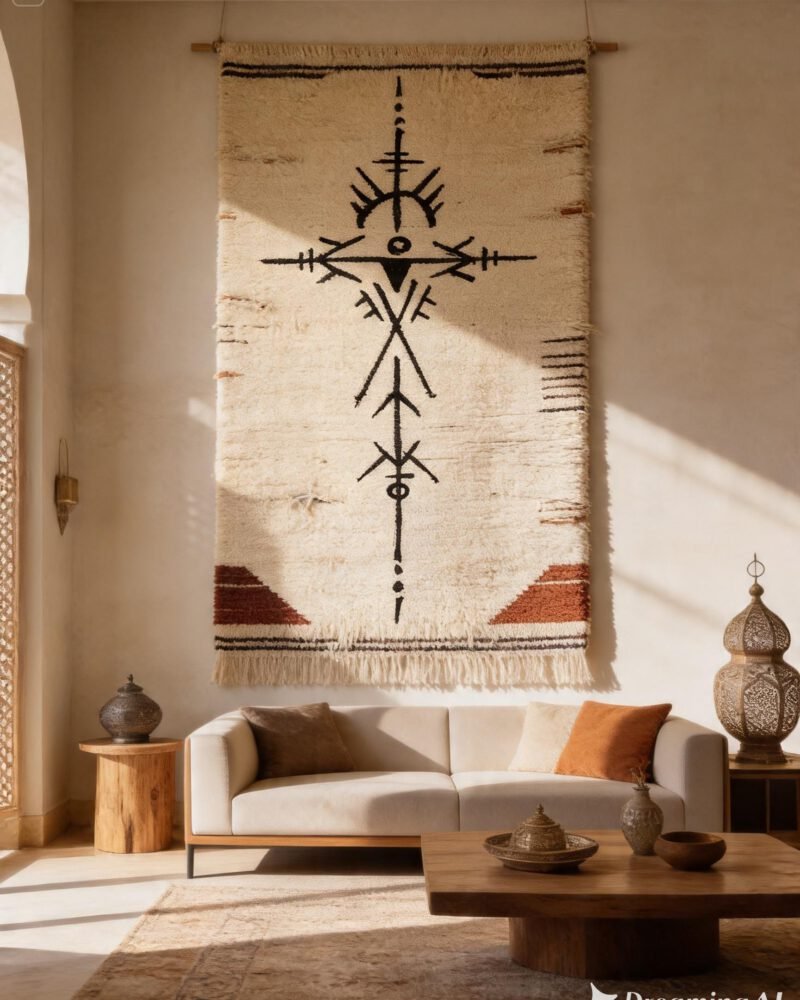
Most wall art is hung too small. A piece that occupies less than half its wall reads as an afterthought; one that fills two thirds looks deliberate. Measure the wall, or the furniture beneath it, and work from there.
A quick test: cut newspaper to the dimensions you are considering, tape it up, and live with it for a day. It is almost always the larger option that wins.
| Width | Works well |
|---|---|
| 80 – 120 cm wide | Narrow hallways, between windows, above a console or a bedside Portrait format. Reads as a single strong accent rather than a statement. |
| 120 – 170 cm wide | Above a two-seat sofa, a double bed, a dining sideboard The most versatile range. Fills the wall without crowding the furniture. |
| 170 – 220 cm wide | Above a three-seat sofa, in a double-height stairwell, a large bedroom wall Becomes the focal point of the room. Needs clear wall on both sides. |
| 220 cm and above | Open-plan living areas, entrance halls, commercial and hospitality spaces Architectural. Consider a batten rail and, above 8 kg, a wall anchor into studs. |
Step two
Choosing colors
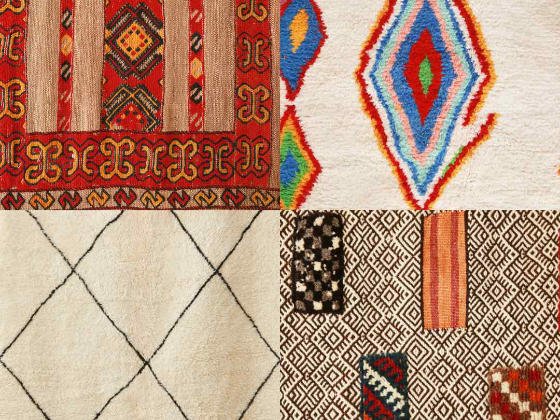
Taznakht weaving spans undyed neutrals to fully saturated madder and indigo. The right choice depends less on taste than on how much colour the room already carries.
-
Neutral & undyed
Cream, oatmeal, natural grey. Adds texture without adding colour — the safest choice in a room that already has a strong palette, and the one that ages best against changing furniture.
Pairs with: oak, linen, lime plaster, black metal
-
Earthy & warm
Terracotta, camel, ochre, walnut. The most flattering range in low or warm light, and the reason a Moroccan piece makes a cold modern room feel finished.
Pairs with: off-white walls, rattan, terracotta tile, brass
-
Bold & saturated
Madder red, burgundy, deep indigo, black-brown. Best used where you pass rather than sit: entrances, stairwells, corridors, or one wall in an otherwise quiet room.
Pairs with: chalk white, charcoal joinery, dark timber
Room by room
Living Room Ideas
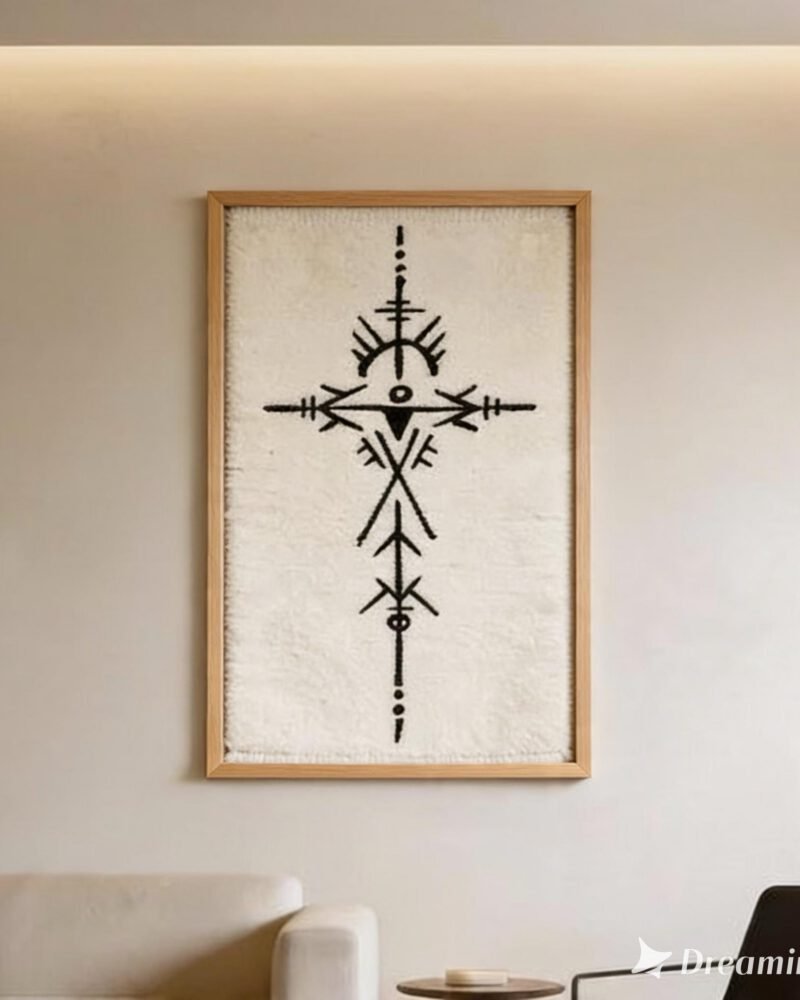
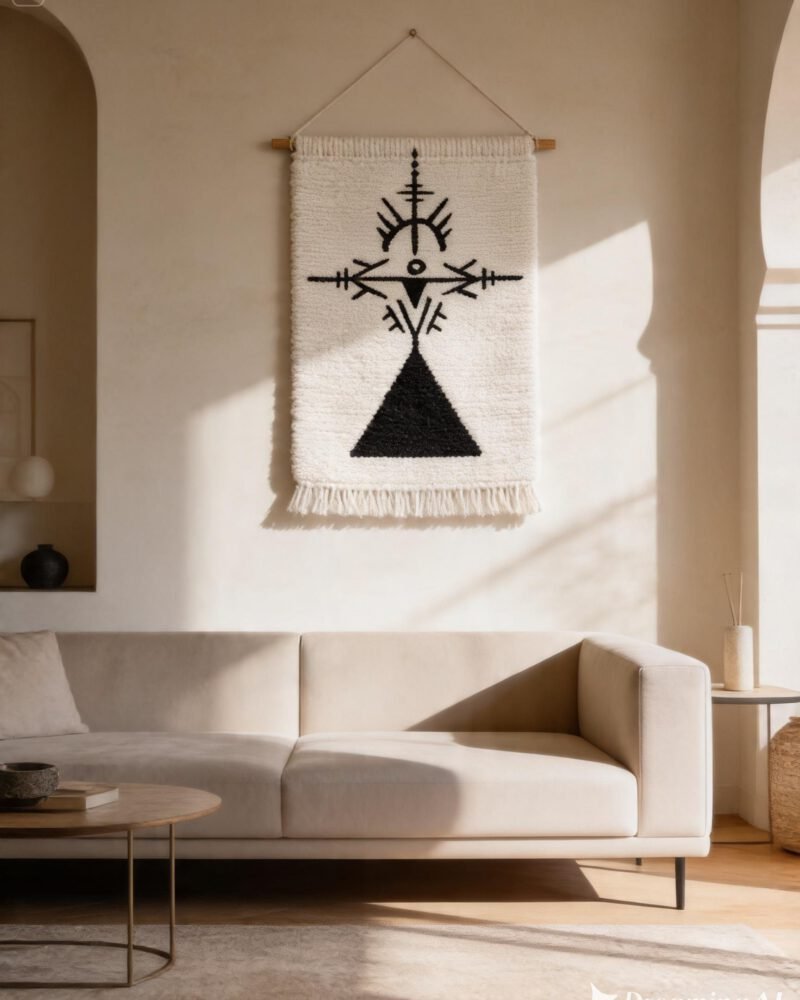
Hang the panel above the sofa, centred, with its lower edge 20–25 cm above the backrest. Let it be the only artwork on that wall — a Taznakht weave has enough pattern that anything beside it competes. Repeat one of its colours in a cushion or a ceramic and stop there.
- Two thirds of the sofa width is the right proportion
- Warm white or clay-toned walls flatter undyed wool
- A wall-washer or picture light brings out the pile at night
Room by room
Bedroom Ideas
Above a bed, a woven panel does the work of a headboard — softer, warmer and quieter than one. Choose a calmer piece here: undyed grounds, low-contrast motifs, one accent colour. The wool also takes the hard edge off morning echo in a room with bare floors.
- Match the panel width roughly to the bed width
- Keep 15–20 cm of clear wall above the pillows
- Avoid the busiest patterns directly above where you sleep
Room by room
Entryway Ideas
An entrance is the one place a bold piece always works: you pass it rather than live in front of it. Go saturated — madder red, deep indigo, a dense geometric field — and hang it opposite the door so it is the first thing seen. It sets the temperature for the whole house.
- Portrait formats suit narrow entry walls
- Hang high enough to clear coat hooks and shoes
- Wool absorbs the slam and clatter of a busy hallway
The practical part
How to hang a rug
- Weigh it, then choose the method Under 6 kg: hooks or a rod through sewn loops. Over 6 kg: a batten in a sleeve, fixed to brackets. Over 10 kg: fix into studs or use heavy-duty anchors.
- Sew a sleeve, never pierce the weave A strip of cotton twill hand-stitched along the top edge on the reverse. Cut the batten 2 cm narrower than the rug so it stays hidden.
- Hang at eye level Centre the piece about 150 cm from the floor, or align its top edge with nearby doorframes so the room reads as one composition.
- Let it settle A rolled piece takes a week or two to hang perfectly flat. Resist ironing it — gravity does the work. Keep it out of direct, sustained sunlight to protect natural dyes.
Why textile
Rug vs traditional artwork
| Quality | Framed print or canvas | Handwoven textile |
|---|---|---|
| Texture | Flat surface behind glass | Physical relief that changes with the light through the day |
| Acoustics | Reflects sound | Absorbs it — noticeably softer in rooms with hard floors |
| Warmth | Visual only | Visual and literal — wool insulates a cold exterior wall |
| Uniqueness | Usually an edition | One piece, unrepeatable even by its own maker |
| Moving house | Fragile glass and corners | Rolls up and travels safely |
Put it into practice
Pieces ready to hang
-
-
Taznakht Wall Art — Red Earth
د.م. 1.150,00 -
Taznakht Wall Art — Atlas Lines
د.م. 980,00 -
Taznakht Wall Art — Sun Symbol
د.م. 1.250,00